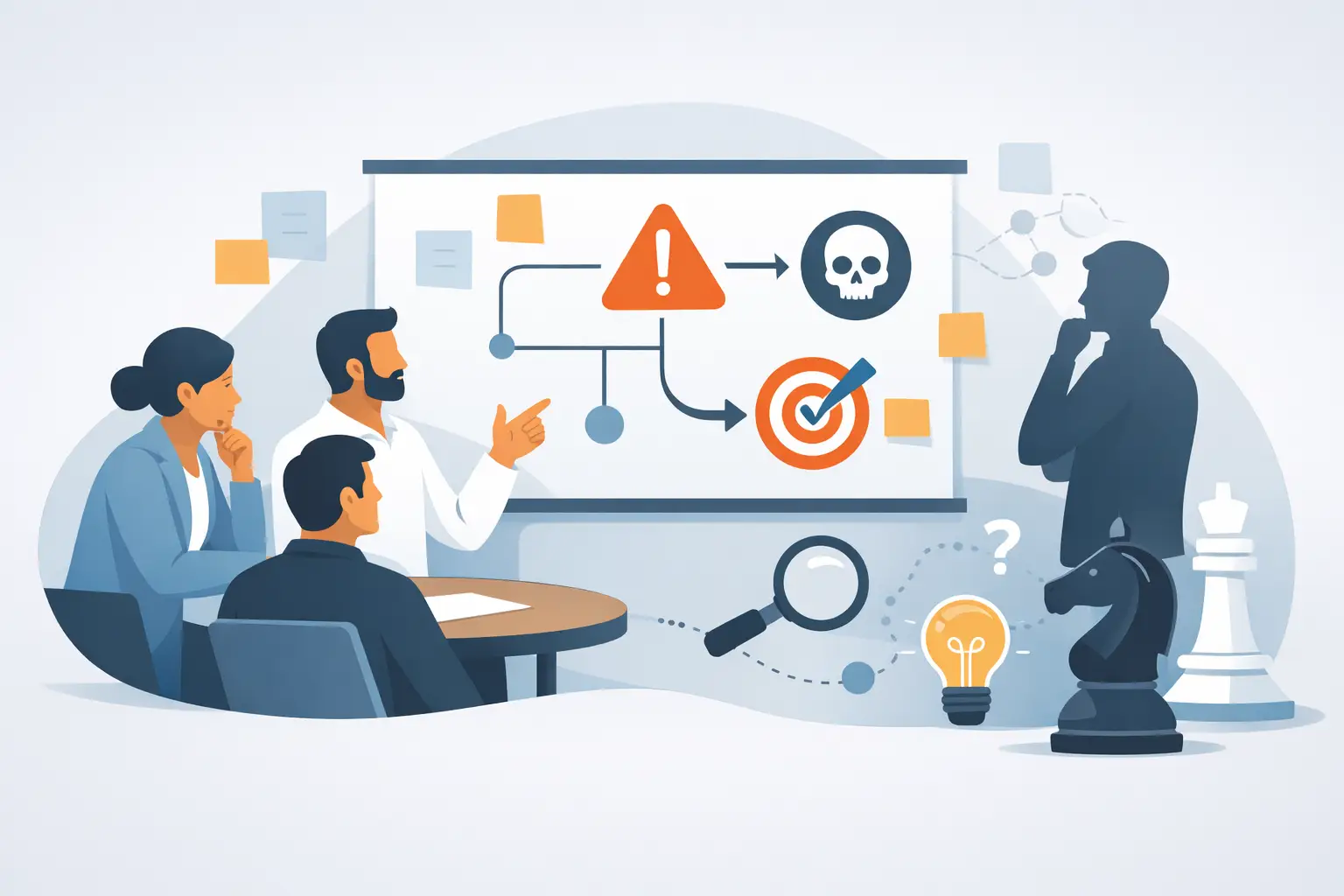
A strategy fails six months from now. Revenue missed. Execution stalled. The board is asking why obvious risks were not surfaced earlier. In most cases, the issue was not a lack of intelligence or effort. It was that the decision process did not create enough permission, structure, or discipline for people to say what could go wrong while the choice was still reversible. A pre mortem strategy workshop is designed for that moment before commitment, when candor still has practical value.
This is not a pessimism exercise. It is a method for improving judgment under pressure. Senior teams use it to test whether a strategy is as sound as it appears, whether confidence is outrunning evidence, and whether alignment is real or simply unchallenged momentum.
What a pre mortem strategy workshop is actually for
A pre mortem starts with a simple premise: assume the strategy has failed, then work backward to identify the most plausible causes. The power of that move is not procedural novelty. It is psychological permission. By placing failure in the future and treating it as a given, the workshop lowers the social cost of raising concerns in rooms where status, speed, and executive advocacy can suppress challenge.
That matters most when the stakes are high. Expansion decisions, major capital allocation, M&A moves, operating model redesign, AI investment, leadership restructures, and turnaround plans often carry a mix of uncertainty and internal pressure. By the time a recommendation reaches the executive team or board, significant energy has usually already been invested in defending it. A pre mortem creates a disciplined counterweight to that tendency.
The goal is not to produce a long risk register. It is to improve the quality of the strategic decision. That means surfacing hidden assumptions, distinguishing reversible risks from existential ones, identifying where ownership is unclear, and testing whether the strategy can withstand informed challenge.
Why senior teams benefit from a pre mortem strategy workshop
Experienced leaders are not short on analytical tools. The constraint is usually different. It sits in the room itself – in incentives, hierarchy, compressed timelines, fragmented information, and the natural tendency to protect decisions that already feel politically or emotionally committed.
A well-run pre mortem strategy workshop helps correct for several common distortions.
First, it exposes overconfidence. Teams often underestimate execution friction, regulatory delay, integration complexity, capability gaps, or market response. What looks achievable at the strategy level can fail in the handoff to operations, governance, or customer reality.
Second, it makes dissent more usable. In many leadership settings, concerns are voiced too late, too softly, or too indirectly to shape the decision. The workshop gives those concerns a legitimate place in the process without turning the session into a personality contest.
Third, it strengthens accountability. If failure scenarios are visible in advance, leaders can no longer claim they were unforeseeable. That does not eliminate uncertainty, but it does improve the quality of ownership.
There is a trade-off, of course. A pre mortem can slow momentum, especially when a team is eager to move. It can also become performative if leaders invite challenge but are not prepared to revise assumptions or alter the plan. The value comes from disciplined adjustment, not from the optics of caution.
When to run one
Timing matters more than format. The workshop is most useful after there is a concrete strategic direction to test, but before the organization has locked itself into irreversible commitments.
Too early, and the conversation becomes abstract. Too late, and the team is merely documenting concerns it no longer has the appetite to act on. The right moment is usually when a strategic proposal has enough definition to be challenged but enough flexibility to be changed.
This often means running a pre mortem before board approval, before closing a major investment, before launching a transformation program, or before cascading a strategy across the enterprise. It can also be valuable after a period of strong internal agreement. Apparent consensus is not always evidence of quality. Sometimes it is evidence that the harder questions never made it into the room.
How an effective workshop is structured
The method itself is straightforward. The discipline comes from how it is framed and facilitated.
Start with the decision, not the agenda
The workshop should begin with a clear statement of the decision under review. What exactly is being proposed? What assumptions does it depend on? What would commitment require in capital, reputation, time, or operating focus?
If the decision is vague, the conversation will be vague. Senior teams often use broad language when sharper definition would expose unresolved choices. A strong pre mortem begins by making the choice legible.
Make failure concrete
Participants should be asked to imagine that the strategy has failed in a defined future period and to explain why. Precision matters here. Failure should not be framed in generic terms. Was the target missed? Did integration break down? Did regulators intervene? Did customers not respond? Did the leadership team fragment under pressure?
The more specific the failure scenario, the more actionable the diagnosis becomes.
Separate signal from noise
Not every risk raised in the room deserves the same weight. Some are routine operating issues. Others point to structural weaknesses in the strategy itself. The task is to identify which risks are most plausible, most consequential, and least mitigated.
This is where facilitation quality matters. Without discipline, workshops can become crowded with speculative concerns that distract from the critical vulnerabilities. With proper structure, the discussion moves toward the few issues that could materially alter the decision or require conditions before approval.
Convert challenge into decision action
A pre mortem strategy workshop should end with consequences, not observations. That may mean changing the strategy, staging the investment differently, adding decision gates, tightening ownership, requiring additional evidence, or documenting explicit board-level conditions.
If the output is merely a list of concerns, the workshop has value but limited effect. The stronger outcome is a clearer decision architecture around the strategy – what must be true, who owns what, what will be monitored, and what would trigger reconsideration.
What often goes wrong
The most common failure is symbolic use. Leaders hold a pre mortem because it signals rigor, but the decision is already socially fixed. Participants sense that, and candor drops. The session then becomes an exercise in safe objections rather than meaningful challenge.
Another problem is poor participant mix. If the room contains only advocates of the strategy, blind spots will persist. If it includes too many peripheral voices, the discussion loses relevance and authority. The right mix usually combines decision owners, operators who understand execution reality, finance or risk voices, and governance participants where appropriate.
There is also a tendency to over-index on downside scenarios while ignoring strategic asymmetry. Some risks are acceptable because the upside justifies them. A mature workshop does not treat all uncertainty as a reason to delay. It clarifies which risks are worth taking and which ones reflect weak framing, inadequate preparation, or confused ownership.
The governance value is often underestimated
For boards and investment committees, the pre mortem is more than a strategy tool. It is a governance instrument. It improves the quality of challenge before formal approval, and it creates a more credible record of how key assumptions were tested.
That matters when decisions become consequential in hindsight. Boards are often criticized either for excessive passivity or for second-guessing management after the fact. A disciplined pre mortem creates a better middle ground. It allows challenge at the right time, while preserving management accountability for execution.
This is one reason firms such as Averi Advisory use pre mortem thinking not as a workshop gimmick, but as part of a broader discipline around executive judgment, strategic framing, and decision ownership.
A better use of pressure
Pressure is not the problem. Senior leaders are paid to make decisions under pressure. The problem is when pressure narrows the field of vision, compresses dissent, and accelerates commitment before assumptions have been properly tested.
A pre mortem strategy workshop does something modest but important. It gives leadership teams a structured pause before commitment, where confidence can be challenged without paralysis and risk can be named without losing momentum. In consequential decisions, that pause is rarely wasted. It is often the point at which judgment becomes visible.